

Hermès doesn't have a waitlist. They have something far more dangerous.
Issue #1 · The Hermès trick that makes customers spend more to buy less


Most of the CEOs I work with have the same private problem, and almost none of them say it out loud. Their best-selling product is also the one they discount first.
The thing customers actually want. The hero piece. The cover image. The one the press writes about. That’s the one that ends up at 30% off in February.
Not because demand disappeared. Because the system behind it was never built to protect demand in the first place.
Buying teams call it planning. Finance calls it inventory risk. If we’re being honest, it’s a structural leak in the system.
Hermès has spent forty years engineering the exact opposite outcome. No loyalty programme. No algorithm. No discounting.
The mechanism is quieter than people realise, and, frankly, a little ruthless.
You won’t do this. Not because you can’t. Because somewhere in your system, growth is still measured in volume.
And that’s the most expensive mistake in retail.
What Hermès actually built
The mechanism is often described by insiders and customers as a kind of pre-spend ratio.
Roughly €1 of “other” Hermès — scarves, homewares, RTW, belts — for every €1 of quota-bag you eventually unlock. In practice, €15K to €30K of relationship before your SA will have the conversation about a Birkin.
There is no waitlist. No app. No queue number. The customer’s purchase history is the queue. And the SA — not a system, not a CRM workflow, a named human — decides when you’re ready.
The result: a 40%+ operating margin against an industry average of 15%. A handbag that has appreciated steadily for three decades, beating the S&P 500 over most of that window. Auction prices have reached into the millions.
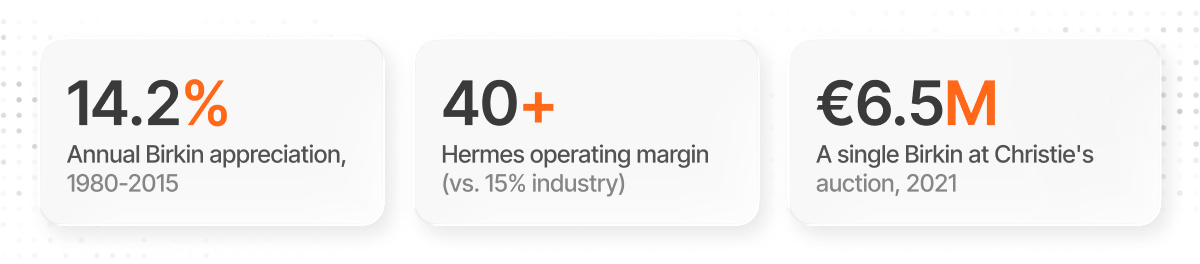
No advertising paid for any of that. The system did.
Why this works, and why your CFO will misread it
The instinct, looking at Hermès, is to read the pre-spend ratio as a clever scarcity tactic. It isn’t. It’s an accounting decision dressed up as a customer experience.
Here’s what’s actually happening underneath.
Sunk cost loyalty, entered voluntarily. Once a customer has spent €20K on the way to a Birkin, walking away from Hermès feels like abandoning an investment, not switching brands. That’s not customer lock-in. That’s customer self-lock-in. The strongest kind.
The endowment effect, applied to the relationship. A customer with a named SA isn’t a shopper anymore. They are, in their own mental accounting, a member. AOV doubles silently the moment that shift happens. Hermès did not build a loyalty programme. They engineered the conditions under which one becomes unnecessary.
Investment framing, owned by the secondary market. Hermès doesn’t run resale data. Christie’s and Rebag do that work for free. The customer mentally re-categorises a €32K bag from “discretionary spend” to “portfolio allocation.” Different budget. Different conversation with a spouse. Same wallet.
The Birkin isn’t rare because Hermès can’t make more. It’s rare because Hermès chooses not to, and has held that choice with absolute discipline for four decades.
That’s the part that doesn’t transfer to a slide. The mechanism is replicable in 90 days. The discipline to hold it is not.
How to steal it for your brand
How to build a version of this in your business
You don’t need a Birkin-equivalent product. You need one hero SKU and the willingness to protect it from your own commercial team.
1. Gate one hero SKU behind relationship depth, not payment. Pick your highest-desire, lowest-supply product. Make it invite-only from your SA team. No checkout button. No waitlist form. A conversation. The friction is the mechanism.
2. Define your pre-spend ratio internally, and never publish it. Hermès has never confirmed theirs. The opacity is part of the system. Your team needs to know it (3+ category purchases in 18 months, say). Your customer should only ever experience it as a personal gesture from their SA.
3. Stop fighting the secondary market. Use it. Screenshot the Vestiaire prices. Send them privately to your top fifty clients. The most powerful sales conversation your SA will ever have is the casual one: “the last one we did is trading at three times retail now.” That sentence does the work of an entire campaign.
4. Give the journey a name. “Atelier Tier.” “The Reserve.” “By invitation.” A noun. The noun becomes the story your customer tells at dinner, and the dinner is your distribution channel.
5. Resist the urge to fill demand. This is the one that will get pushback. Your CFO will model the foregone revenue. Your commercial director will frame it as a missed quarter. Both will be right on a spreadsheet and wrong on a P&L over five years. The moment a hero SKU becomes easy to buy, it stops being the hero. One desperate restock will not kill you in Q2. It will quietly cost you the brand by Q8.
A soft version of all of this — a private product page, SA-referral access, a named-relationship tier — will tell you within sixty days whether your customer base has the appetite for it.
Most do. Your system is what doesn’t.
— Susan
Retail Ideas · One powerful retail tactic, every week. Written by Susan Jeffers.