

Hermès doesn't have a waitlist. They have something far more dangerous.
Issue #1 · The Hermès trick that makes customers spend more to buy less

Walk into any Hermès boutique and ask for a Birkin.
They’ll smile. They’ll say there are none available. Then, if you’re polite about it, your Sales Associate will quietly explain what it takes to get one.
Spoiler: it’s not money.
It’s other money. Spent first. On other things. Over months or years.
Homophonic priming, but make it retail: Hermès invented a system where the customer’s purchase history is the waitlist. No database. No app. No queue number. Just a quiet, unwritten rule that you must earn the right to spend €32,000.
They call it the pre-spend ratio. Spend roughly €1 on scarves, homewares, RTW, and belts for every €1 of quota-bag you want to unlock. In practice, that means €15K–€30K in “other” Hermès purchases before your SA will even have the conversation.
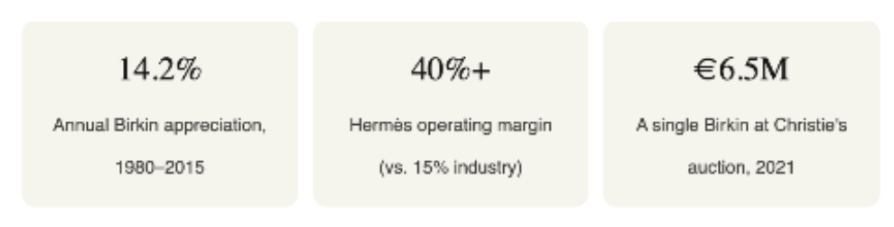
The result? The Birkin beats the S&P 500. And Hermès has a 40%+ operating margin with no discounts, no e-commerce, and almost no advertising.
Why this psychological trick works so well
Your customers want what they can’t have, but they’ll pay for the journey too.
The pre-spend ratio stacks three of the most powerful forces in consumer psychology:
💸 Sunk cost loyalty. Once a customer has spent €20K at Hermès “on the way” to their Birkin, walking away is almost psychologically impossible. They’re not buying a bag — they’re protecting an investment of time, money, and identity.
🧠 The endowment effect. Customers who’ve built a relationship with a named SA don’t feel like shoppers anymore. They feel like members. That shift from transactional to relational is where AOV doubles.
📈 Investment framing. A Birkin isn’t a handbag. It’s an asset class. Hermès has published enough resale data — and stood back while Christie’s and Rebag do the rest — to let customers mentally account for the purchase as portfolio allocation, not discretionary spend. Completely different budget. Completely different conversation with a spouse.
The Birkin isn’t rare because Hermès can’t make more. It’s rare because Hermès chooses not to.
That choice — exercised with total discipline over 40 years — is the entire moat.
How to steal it for your brand
You don’t need a Birkin. You need one hero SKU and the guts to protect it.
Here’s the minimum viable version, implementable in 90 days:
Gate one hero SKU behind relationship depth, not payment. Pick your highest-desire, lowest-supply product. Make it invite-only from your SA team. No checkout button. No waitlist form. A conversation.
Define your “pre-spend ratio” internally. You don’t need to publish it. Your SAs need to know it. A customer who’s bought 3+ categories in the last 18 months gets access. One-time buyer does not.
Actively amplify your resale market. Hermès doesn’t control StockX — they just don’t fight it. Screenshot the Vestiaire prices. Share them with clients. The secondary market is your free marketing department.
Give the journey a name. “Our Atelier Tier.” “The Reserve.” “By invitation.” The ritual needs a noun. The noun becomes the story your customer tells at dinner.
Resist the urge to fill demand. The moment you make the hero SKU easy to get, it stops being the hero. This is the discipline Hermès has held for four decades. One bad quarter will not kill you. One desperate restock will.
Worth an experiment 👀 — even a soft version (private product page, SA-referral access, named waitlist) will tell you within 60 days whether your customer base has the appetite for it. Most do.
PS: I also run XY Retail. We make implementing ideas like these 10x faster than legacy systems. Customers include Giorgio Armani Group, Golden Goose, and Fender.
Click here to talk with my team.
— Susan