

Patek Philippe had a 4-year waitlist. So they discontinued the watch.
Issue #3 · The watchmaker who decides whether you're allowed to buy what you've offered to pay for


Patek Philippe runs a system most retailers think is illegal. It is also why their watches appreciate faster than property.
Most premium retail CEOs I work with measure their commercial teams on the same thing: convert the high-intent customer. The walk-in who knows the product, has the budget, has the time. Closing that customer is the entire job.
I want to suggest, calmly, that this is the most expensive instinct in your business.
The high-intent customer who walks in ready to buy is also the customer least likely to come back twice if they get what they came for on day one. Volume of conversions is the metric the commercial team is measured on. Quality of the customer base is the metric the brand is built on. Your system rewards the first and quietly punishes the second.
Patek Philippe noticed this earlier than most luxury houses, and they did something about it that still shocks people who haven’t been paying attention.
They built a system that decides whether to let you buy.
What Patek actually built
For the most desirable Patek references, the Nautilus 5711, the Aquanaut 5167, the perpetual calendar lines, a customer cannot simply walk into an authorised dealer and pay. The customer is asked to fill out a purchase intent form. They explain why they want that specific reference. What other Pateks they own. How long they have collected. What the watch will be worn to.
The dealer reviews it. The brand sometimes reviews it. And the brand, or the dealer on its behalf, says no to a meaningful percentage of qualified, willing-to-pay customers.
This is not a waitlist. A waitlist is “we will get to you.” This is “we are deciding whether you are the right customer for this watch.”
The mechanism produces three numbers that are difficult to argue with.
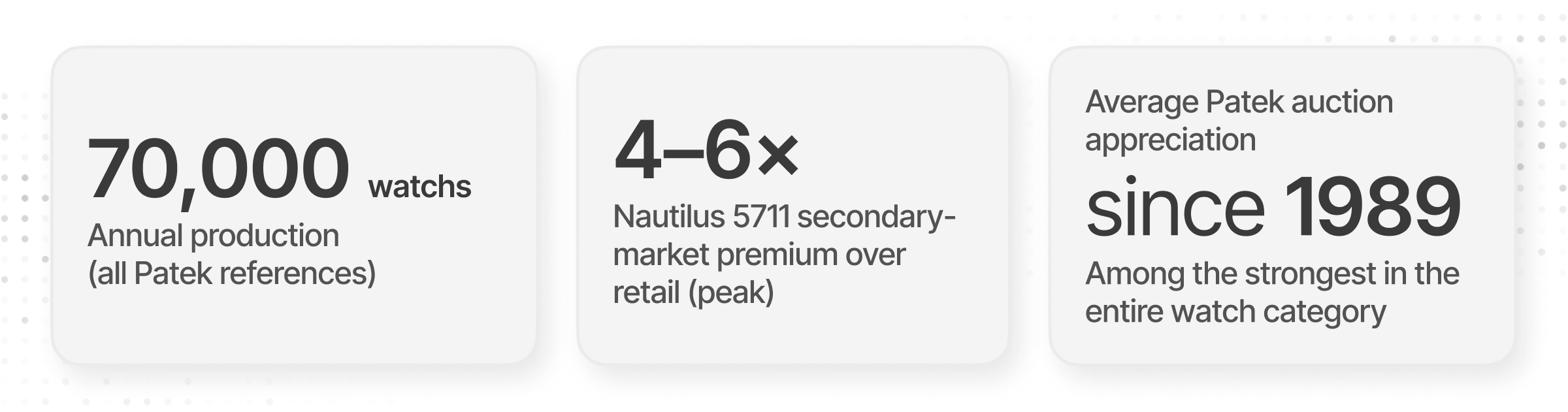
Roughly 70,000 watches a year against global demand that runs in the hundreds of thousands. The constraint isn’t manufacturing capacity. Patek could produce more. They have actively chosen not to, for two centuries, and they have built an allocation system that protects that choice from being eroded by their own commercial team.
The dealer doesn’t get a bigger commission for selling more Pateks. The dealer’s continued allocation depends on selling them to the right people. The system rewards the sales associate for qualifying, not for converting.
That is the inversion. Almost no other retailer in the world has built this.
Why this works, and why your commercial director will misread it

The instinct, looking at Patek, is to read the purchase intent form as a vanity gate. Of course Patek can be picky. They make watches that appreciate. Most brands can’t afford this.
That reflex misses the causality. Patek is not picky because their watches appreciate. Their watches appreciate because Patek is picky. The selectivity creates the conditions under which appreciation happens. The mechanism is the cause, not the consequence.
Three things are happening underneath:
The customer base is curated, not collected. A Patek collector who has been allocated a Nautilus is, by definition, someone the brand has approved. They are part of a small population that the brand can talk to, sell to, and retain over forty years. A retailer who sells to anyone with a credit card is collecting transactions. Patek is curating a relationship pool. The economics of those two strategies diverge dramatically over time.
The secondary market is a brand asset, not a brand threat. Most luxury houses spend significant resources fighting the secondary market. Patek lets it run, because the secondary market is doing a job the brand could not do for itself: it is constantly pricing the brand’s desirability in public. Every record-setting auction is an unpaid advertisement that Patek can point to without ever speaking. The brand doesn’t promote the secondary market. It also does nothing to suppress it.
The dealer network is incentivised to protect the brand, not to maximise volume. This is the structural piece that almost no one copies. Most luxury brands push their dealers to hit revenue targets. Patek’s dealer agreements are different in a single, important way: dealer allocation depends on the quality of the customer the dealer brings in, not the volume. A dealer who sells a Nautilus to a flipper loses allocation. A dealer who sells it to a fifteen-year customer keeps it. The incentive runs in the opposite direction to almost every retailer in the world.
The deeper truth is the one most luxury operators do not want to sit with. Most retailers do not have a customer-quality strategy. They have a customer-volume strategy with luxury pricing painted on top.
How to build a version of this in your business
You do not need a two-century brand and a watch that appreciates 6× over retail. You need to ask, at the level of one product line, *who should we be selling this to?* and have an answer that isn’t “anyone with the money.”
Pick one product line and define its ideal customer in writing. Not a marketing persona. A real definition. *”We want this product in the wardrobes of women who already own three Loro Piana cashmeres, not on Vinted within four months.”* The definition will feel uncomfortable to write down. That is the point. A definition you cannot defend out loud is not a definition.
Build a soft qualification step into the customer journey. Not a form. A conversation. The SA asks the customer about other purchases they have made, what they wear it with, what occasions they are buying for. It is framed as service. It is also a qualification step. The information goes into the customer record. The next allocation decision is informed by it.
Allow your team to say no, and protect them when they do. This is the structural piece. Your SAs and store managers will refuse to qualify customers if they fear losing the sale, the commission, or the manager’s quarterly bonus. The behaviour you want at the customer-facing edge is determined entirely by what you measure at headquarters. Change the measurement, and the behaviour follows. Leave the measurement as conversion rate, and no qualification system will hold for ninety days.
Stop treating the secondary market as a problem. Resale is the most accurate signal of brand health you have. If your products are not appreciating on Vestiaire and StockX, your brand is not as desired as you believe it is. If they are appreciating, that is information your sales team should be using actively, not data the legal team is trying to suppress. The position to take is: we do not control resale, and we are happy to be priced by people who love the brand enough to buy it twice.
Reset the dealer or wholesale relationship around customer quality. This is the hardest one, and the one most retailers will not do. The wholesale partner whose top customer is a flipper or an off-price consolidator is not building your brand. They are mining it. Most premium brands are still measuring their wholesale partners on volume and discount discipline. Patek measures them on the customer their watches end up with. That single measurement change reshapes who you sell to, who they sell to, and where your brand ends up two years from now.
A soft version of this, one product line, one qualification step, one rewritten dealer scorecard, will tell you within six months whether your customer base is the one your brand thinks it has.
Most premium retailers are running a volume business that calls itself a luxury one. The audit takes ninety days. The accounting is uncomfortable.
Customer quality is the only thing you cannot buy back later.
— Susan
Reply and say hi. I read every one.